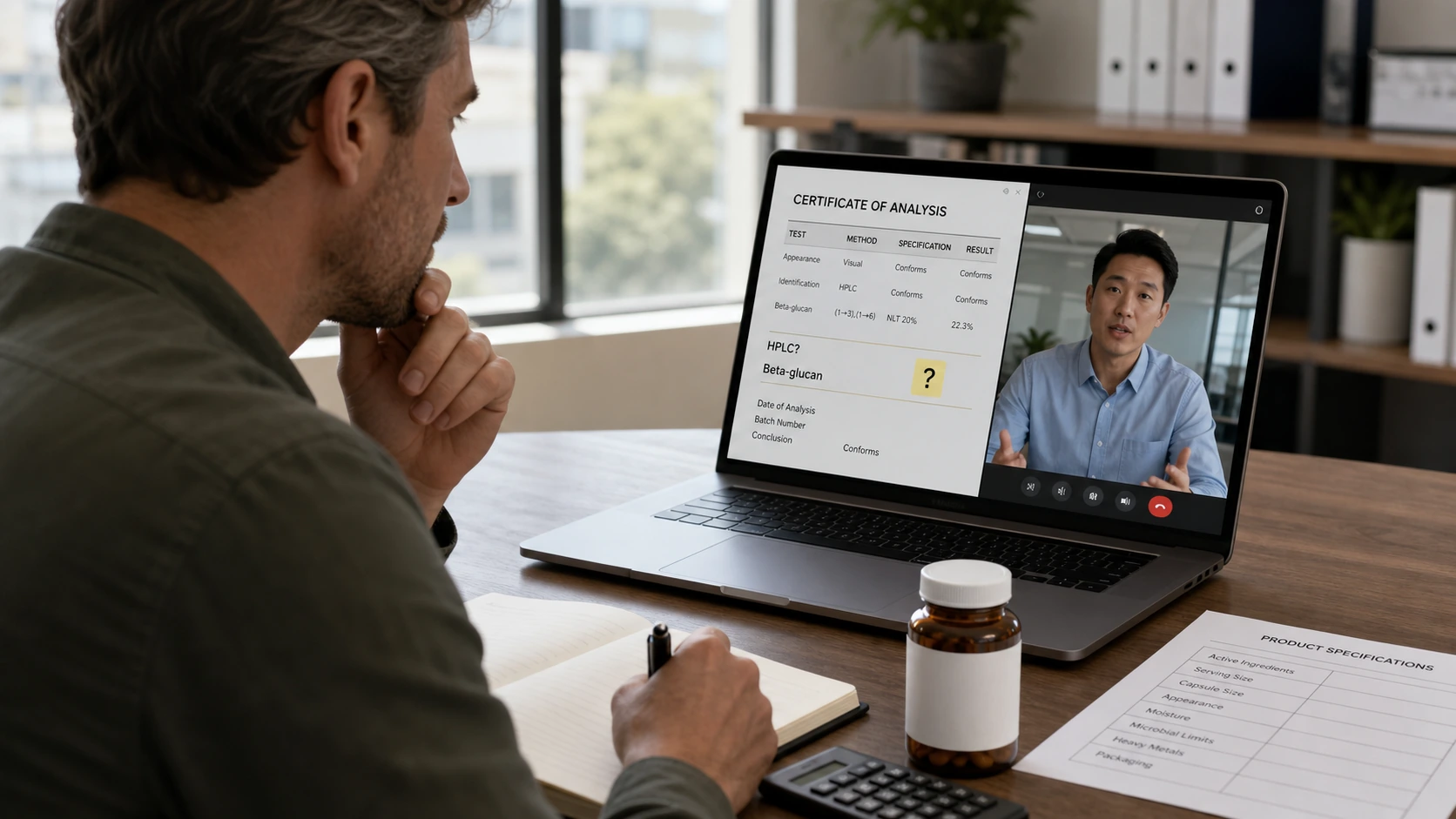
It was a Thursday afternoon video call. A supplement brand owner from Vancouver had been sourcing ingredients for three months. His lion’s mane capsule line was scheduled to launch in six weeks. He pulled up a COA on his screen — one his current supplier had emailed the day before — and asked a question he hadn’t thought to ask three months earlier: “Where does this beta-glucan number come from? Is this HPLC or a colorimetric assay?”
The supplier’s representative paused. “I’ll have to check with our lab team.”
That pause cost him six weeks and a product launch. Finding the right private label mushroom extract supplier isn’t about price lists. It’s about knowing which questions to ask before you’re already in that position.
What “Private Label” Actually Means When You’re Buying Mushroom Extract
Private label and white label are not the same thing, and the distinction shapes your entire sourcing strategy.
White label refers to purchasing a finished, pre-formulated product and applying your own branding — the supplier’s standard dose, their standard species blend, their capsule count. Private label means working with a manufacturer to build something specific to your brand: your extract concentration, your species blend, your capsule format, your label reviewed against your target market’s regulations.
For most supplement brands entering the functional mushroom category, this distinction matters before the first purchase order. A white label arrangement launches faster but gives you nothing proprietary — the same product exists under a dozen other brands. A private label OEM mushroom supplement relationship, when built with the right supplier, produces a formulation that’s genuinely yours.
The practical implication: when you ask about a supplier’s private label program, you’re asking whether they have the infrastructure to hold your formula, adjust beta-glucan targets to your spec sheet, and supply under your label with compliant documentation for your specific market.
The First Question Every Serious Buyer Asks a Private Label Mushroom Extract Supplier
Fruiting Body vs. Mycelium: Why This Defines Your Entire Product
This is where most private label mushroom extract sourcing conversations either move forward or fall apart.
Fruiting body extract refers to material derived from the actual mushroom — the visible cap and stem that emerge above the substrate. Mycelium extract comes from the fungal root network, typically grown on grain in a lab setting. The difference matters because beta-glucan, the primary bioactive compound behind most of the immune and cognitive benefits your customers are paying for, is significantly more concentrated in fruiting bodies than in grain-grown mycelium.
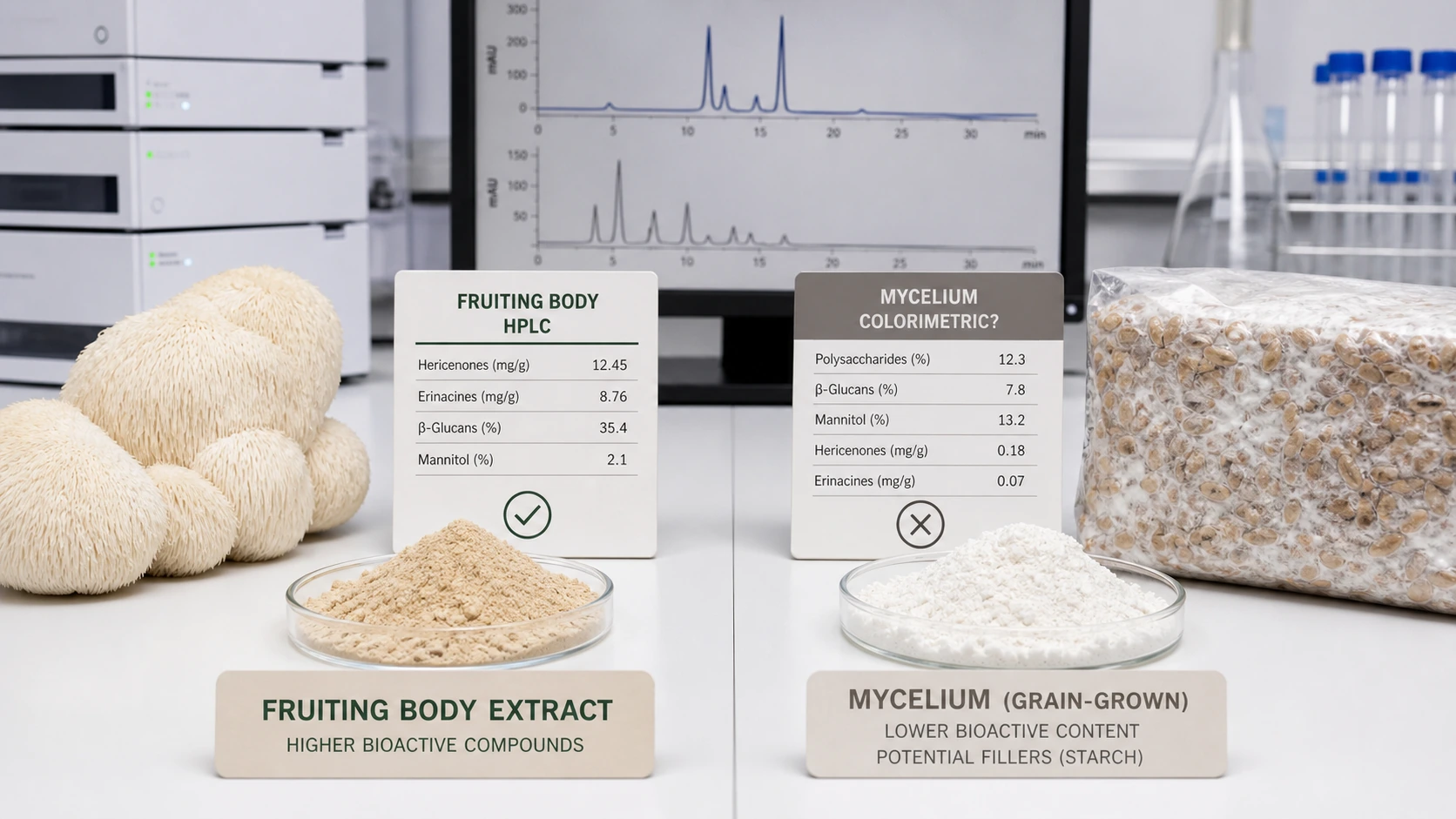
At Hangzhou Molai Biotech, the decision to source exclusively from fruiting bodies — no mycelium, no grain substrate filler — followed a quality audit in 2021. A European retail buyer sent a side-by-side HPLC comparison: a fruiting body lion’s mane batch at 28.4% beta-glucan versus a mycelium batch from a different Chinese supplier at 6.1%. Both were labeled “lion’s mane extract 10:1.” That document became an internal reference point. The team tightened sourcing protocols: every batch now specifies species, cultivation method, and harvest timing, with Eurofins or SGS third-party verification before release. Current lion’s mane fruiting body batches consistently test between 25% and 32% beta-glucan by HPLC.
| Specification | Fruiting Body Extract | Mycelium Extract (grain substrate) |
|---|---|---|
| Beta-Glucan content (HPLC) | 20–32% typical range | 3–8% typical range |
| Primary filler material | None | Residual grain starch |
| Third-party verification | Standard (Eurofins / SGS) | Varies by supplier |
| Regulatory scrutiny (EU) | Lower risk | Higher risk for label claims |
| Cost per kg | Higher | Lower |
When you’re evaluating a private label mushroom extract supplier, ask for HPLC-verified COAs from a named third-party lab — not an in-house certificate. If the supplier can’t tell you the analytical method behind the beta-glucan figure, that’s the pause you don’t want to hear six weeks before your launch.
Minimum Order Quantities and the Conversation Nobody Prepares For
What 25kg MOQ Actually Means for a Launch-Stage Brand
Minimum order quantities are the first friction point for new supplement brands exploring private label mushroom extract manufacturing — and among the most misunderstood.
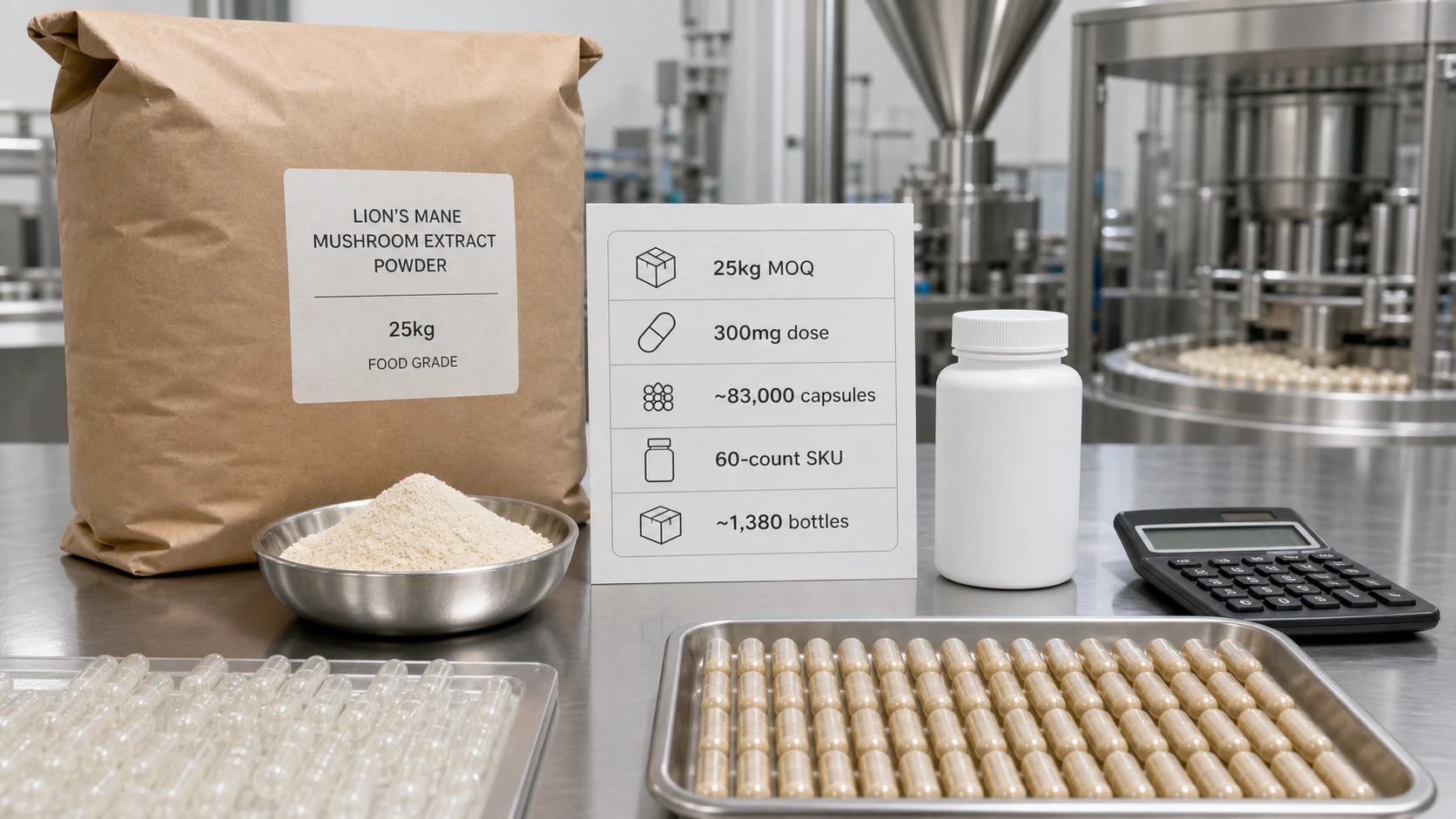
A 25kg minimum order of lion’s mane extract powder translates to roughly 83,000 capsules at a standard 300mg dose. For a brand launching a 60-count SKU, that’s approximately 1,380 units — enough to test retail placement, run a DTC launch, and gather customer feedback before committing to a larger production run. For most functional mushroom brands at launch stage, 25kg is workable once the math is done.
The friction comes from brands that haven’t run that calculation. A Canadian brand building a mushroom blend supplement reached out with a specific concern: their initial projection called for only 10kg of a lion’s mane and reishi dual-extract blend. They’d been told by another supplier that 50kg was the absolute floor.
The conversation that followed took three emails. The resolution came down to product architecture: instead of a soft launch with a single SKU, the brand consolidated two planned products — a lion’s mane focus capsule and a reishi sleep blend — into a single 25kg order split across both species. Both products hit their MOQ. Both launched on schedule. The brand reordered at 50kg the following quarter.
The point isn’t that every MOQ negotiation ends this way. It’s that the conversation is worth having early. A supplier worth working with helps you find a path forward rather than treating the minimum as a conversation-ender.
Certifications Every Private Label Mushroom Extract Supplier Should Hold
When USDA Organic Wasn’t Enough
A private label mushroom extract supplier serving US brands primarily will typically carry USDA Organic certification. That covers your US and Canadian market claims. It does not cover EU retail placement or EU-labeled supplement sales, which require EC 848/2018-compliant EU Organic certification issued through an accredited EU control body.
In 2022, a UK-based functional food brand approached Molai Biotech with an OEM requirement for a turkey tail and chaga blend. Their US formulator needed USDA Organic documentation. Their UK operations manager needed EU Organic for a planned Whole Foods UK listing. At the time, the EU Organic certification was in process — the audit had been completed, but the certificate hadn’t been issued.
The brand had a four-month development timeline. The honest answer was: USDA Organic is confirmed now, EU Organic will clear within your window, and we’ll hold the formula under EU protocol until it does. The supplier provided the audit report and pending certification reference number. The brand accepted the timeline.
The EU Organic certificate was issued eleven weeks later. The product launched on schedule.
The detail that matters here isn’t that everything worked out — it’s that the supplier was transparent about what was in hand versus what was pending. In B2B supplement sourcing, documentation is auditable. Gaps get found eventually. The supplier who tells you exactly where their certifications stand is the one worth building a long-term relationship with.
Current certifications at Molai Biotech: USDA Organic, EU Organic, GMP, ISO 22000, Kosher, and Halal. Commercial batch COAs from Eurofins and SGS are available on request.
Label Compliance: What a Private Label Mushroom Extract Supplier Must Actually Provide
Label compliance requirements differ by market, and they’re often the piece that catches new supplement brands off-guard when sourcing is already underway.
For US brands, FDA 21 CFR Part 111 GMP compliance is the manufacturing baseline. Your supplier’s GMP certificate covers their process. Your finished product label must comply with DSHEA requirements, which govern structure/function claims. “Supports immune function” is permissible with proper notification to the FDA. “Treats infections” is not. A supplier can advise on what documentation your ingredient file requires — species verification, extraction method records, beta-glucan content data from third-party testing — but the label review is your responsibility or your regulatory consultant’s.
For Canadian brands, Natural Product Number (NPN) registration through Health Canada requires specific ingredient-level documentation: a species verification letter, extraction method confirmation, and polysaccharide or beta-glucan content data. Most established OEM mushroom supplement manufacturers will have these documents on file and can provide them in the required format.
For EU brands, Novel Food status applies to several mushroom species — including lion’s mane (Hericium erinaceus) — in certain extract concentrations and formats. This is a live regulatory area. Any supplier telling you EU label compliance for mushroom extracts is simple is either uninformed or isn’t accounting for your specific product form.
The practical checklist starts with your target market before your formula. Know which claims you’re making, which regulatory body governs each market, and which documents your product needs before you finalize your spec sheet.
Frequently Asked Questions
What is the difference between white label and private label for mushroom supplements?
White label means purchasing a pre-formulated finished product and applying your own branding — the supplier’s standard dose, species blend, and capsule count. Private label means developing a formulation specific to your brand: your extract concentrations, species ratios, and label copy reviewed for your target market. Private label requires more development time but produces a proprietary product. For brands building a differentiated functional mushroom line, private label is the standard OEM approach.
What minimum order quantities should I expect from a private label mushroom extract supplier?
Most established suppliers set a 25kg MOQ per extract for private label mushroom supplement production. At a standard 300mg dose, 25kg yields approximately 83,000 capsules. For brands launching multiple SKUs, consolidating formulations to reach a single MOQ threshold is a common approach that avoids over-commitment at launch. Sample quantities are typically available on shorter lead times — 48-hour sample dispatch is standard at Molai Biotech.
Can a supplier help with label compliance for US supplement regulations?
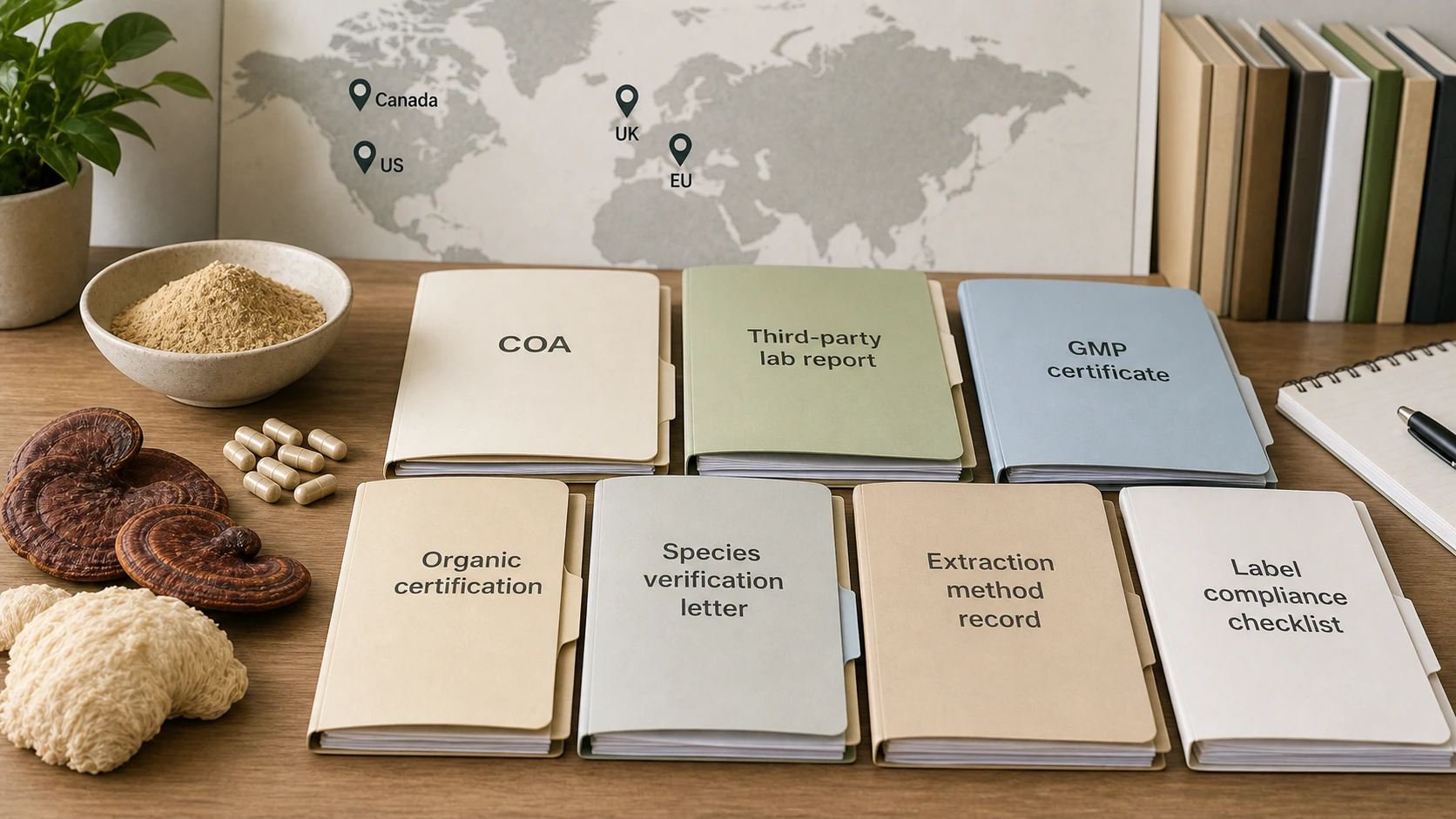
An experienced private label mushroom extract supplier can provide the documentation your brand needs — COAs, species verification letters, extraction method records, GMP and organic certificates, and third-party lab results. The compliance review of your actual label copy is your responsibility or your regulatory consultant’s. Suppliers with genuine US export experience will flag common labeling issues and format documentation to meet FDA or Health Canada requirements.
How do I verify the beta-glucan content listed on a mushroom extract COA?
Ask whether the figure was determined by HPLC (high-performance liquid chromatography) or by a colorimetric assay. HPLC is more precise and is the method preferred by most regulatory bodies. If the COA doesn’t state the analytical method, request clarification before accepting the document. Reputable third-party labs — Eurofins and SGS among them — always include the test method in their reports. If a supplier’s COA omits this information, it’s a reasonable question to ask before placing any order.
Before You Send That First Inquiry
Supplement brands that find a reliable private label mushroom extract supplier for the long term tend to do one thing the others skip: they ask for documentation before they discuss price.
The sequence matters. Price is a function of specification — extract concentration, certification scope, packaging format, batch size. A supplier who quotes before understanding your spec is quoting a number that will change. A supplier who asks about your target market, your intended label claims, and your minimum beta-glucan requirement before giving a number has done this before.
If you’re building a private label mushroom supplement line for the first time, start with three documents: a COA from a recent commercial batch, the third-party lab report behind it, and the supplier’s current GMP certificate. Those three pieces tell you more about a supplier than any product catalog or sales call.
What does your current COA documentation actually require for your target market? That’s usually where the real sourcing conversation starts.