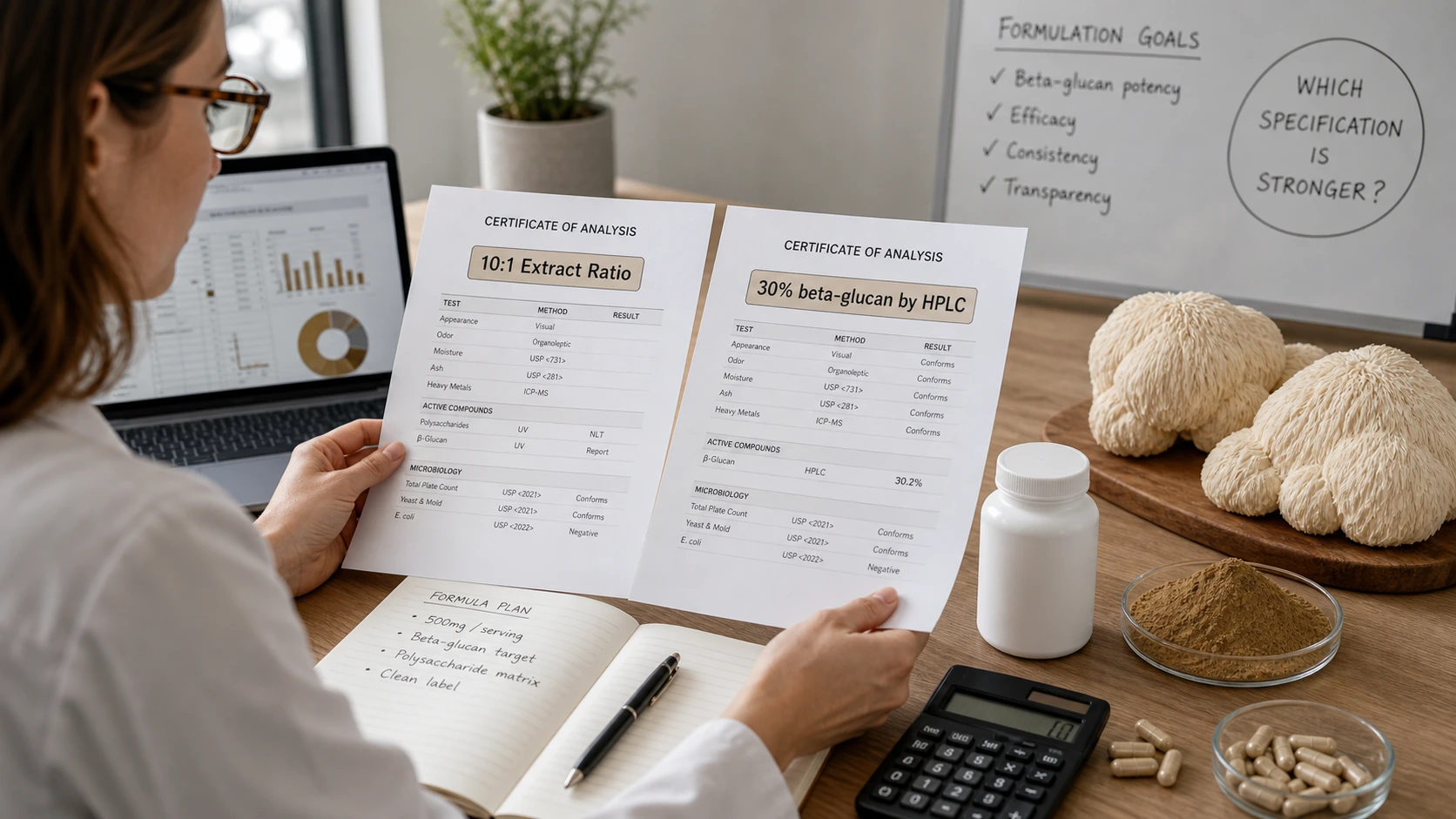
A nutritional formulator in New Jersey once sent two COAs to the factory with a single question attached: “These are both lion’s mane extract powders from two different suppliers. One says 10:1. The other says standardized to 30% beta-glucan. Which one is stronger?”
It’s a reasonable question. The answer is that the 10:1 figure tells you almost nothing about potency — and that the difference between extract ratio vs standardized extract is one of the most consequential specification gaps in functional mushroom powder sourcing. Understanding it protects your product claims, your label compliance, and your relationship with contract manufacturers who will eventually run your formula.
What a 10:1 Extract Ratio Actually Means on a Mushroom Extract COA
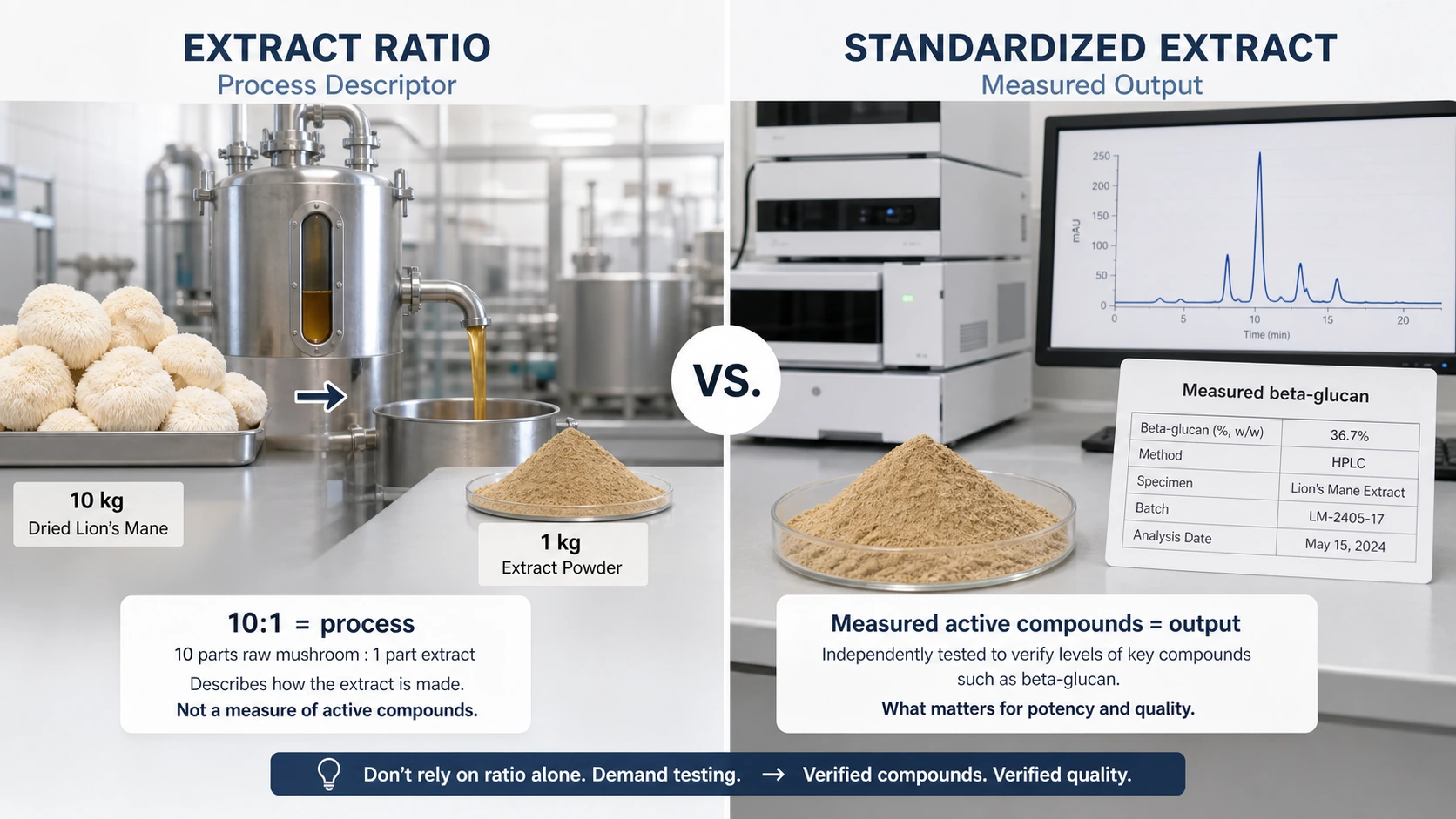
Extract ratio is a concentration descriptor. A 10:1 extract ratio means it took 10 kilograms of raw dried mushroom material to produce 1 kilogram of finished extract powder, through a concentration and drying process. By weight, the extract is ten times as concentrated as the raw starting material.
That’s the entire claim. The ratio says nothing about what compounds ended up in that 1 kilogram, at what percentage, or how those compounds were measured.
This matters because mushroom raw material is not uniform. A 10:1 lion’s mane extract made from high-grade fruiting bodies harvested at peak maturity will have a meaningfully different beta-glucan profile than a 10:1 extract made from lower-quality material or from mycelium grown on grain substrate. Both would carry identical ratio designations. A buyer comparing them on ratio alone has no way to know the difference from the COA.
The 10:1 figure is a manufacturing process descriptor. It is not a potency guarantee.
What Standardized Extract Means — and Why It’s a Different Kind of Claim
Standardized extract refers to a finished extract powder that is guaranteed to contain a specified minimum percentage of one or more active compounds, verified by analytical testing.
A standardized mushroom extract powder labeled “standardized to 30% beta-glucan by HPLC” means the manufacturer has tested each batch using high-performance liquid chromatography and confirmed that beta-glucan content meets or exceeds 30% of the total powder weight. The percentage is a measured outcome, not a process description.
This distinction is the core of the extract ratio vs standardized extract debate in supplement formulation. Ratio describes inputs. Standardization describes verified outputs.
| Specification Type | What It Measures | What It Guarantees | Third-Party Verifiable |
|---|---|---|---|
| Extract ratio (e.g., 10:1) | Starting material vs. finished weight | Concentration process only | No — ratio is self-reported |
| Standardized extract (e.g., 30% beta-glucan) | Active compound % by HPLC | Minimum potency per batch | Yes — via COA from named lab |
| Standardized extract (polysaccharides 30%) | Total polysaccharide % by UV/Vis | Broader compound class | Yes — with method noted |
From a formulator’s perspective, this table represents a straightforward risk difference. A ratio spec can be verified only by trusting the supplier’s process. A standardized spec can be verified by requesting the third-party lab report behind the COA.
Why Extract Ratio Alone Cannot Protect Your Formulation
The Batch That Failed Potency Testing
Here is the friction that comes with ratio-only sourcing.
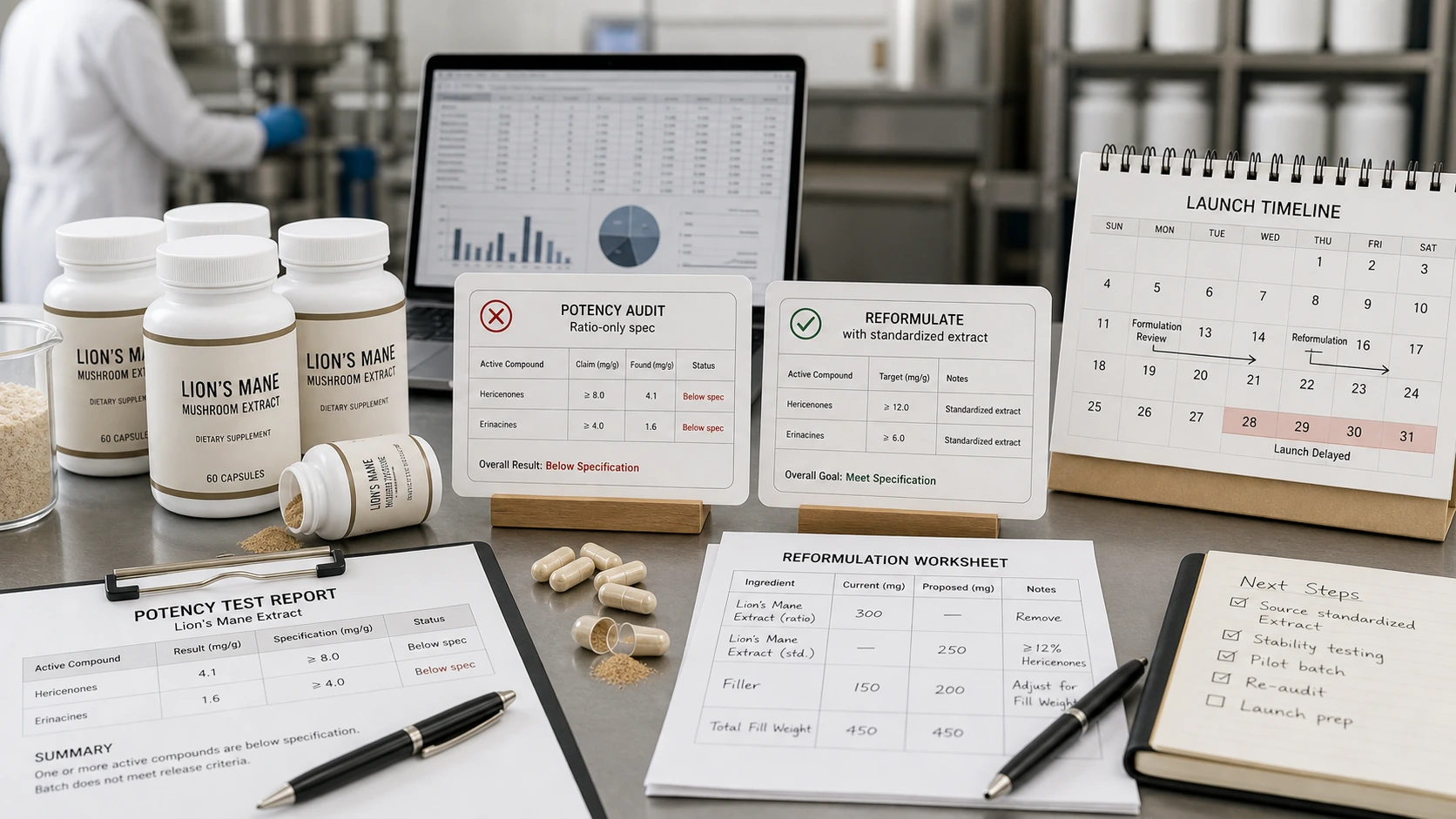
A US nutraceutical brand was building a lion’s mane cognitive support product. Their contract manufacturer quoted two ingredients: a 10:1 lion’s mane extract at $42/kg and a fruiting body standardized extract at 25% beta-glucan at $68/kg. The brand chose the 10:1 on cost. The supplier’s COA looked clean — ratio stated, heavy metals within range, microbial counts acceptable.
Eight months later, during a voluntary third-party potency audit ahead of a retail partnership, the finished capsules tested at 4.2% beta-glucan per capsule against a label claim that implied significantly more. The ratio extract had been legitimate — the process was as described. The raw material quality simply hadn’t produced a potent extract. The batch had to be reformulated.
The brand absorbed the reformulation cost, pushed back their retail launch by eleven weeks, and reordered using a standardized extract specification.
From the factory side, this outcome is not unusual with ratio-spec purchasing — and it’s why Molai Biotech’s commercial mushroom extract powder line is built around standardized specifications rather than ratio claims. Current reishi extract batches are standardized to 30% polysaccharides and 4% triterpenes by HPLC. Lion’s mane batches are standardized to 25–30% beta-glucan. Every batch ships with a Eurofins or SGS COA that includes the analytical method, not just the result.
The cost difference between ratio and standardized is real. The risk difference is also real — and shows up at the worst possible time.
How to Compare Two Suppliers Using Different Extract Specifications
Reading a COA Side by Side
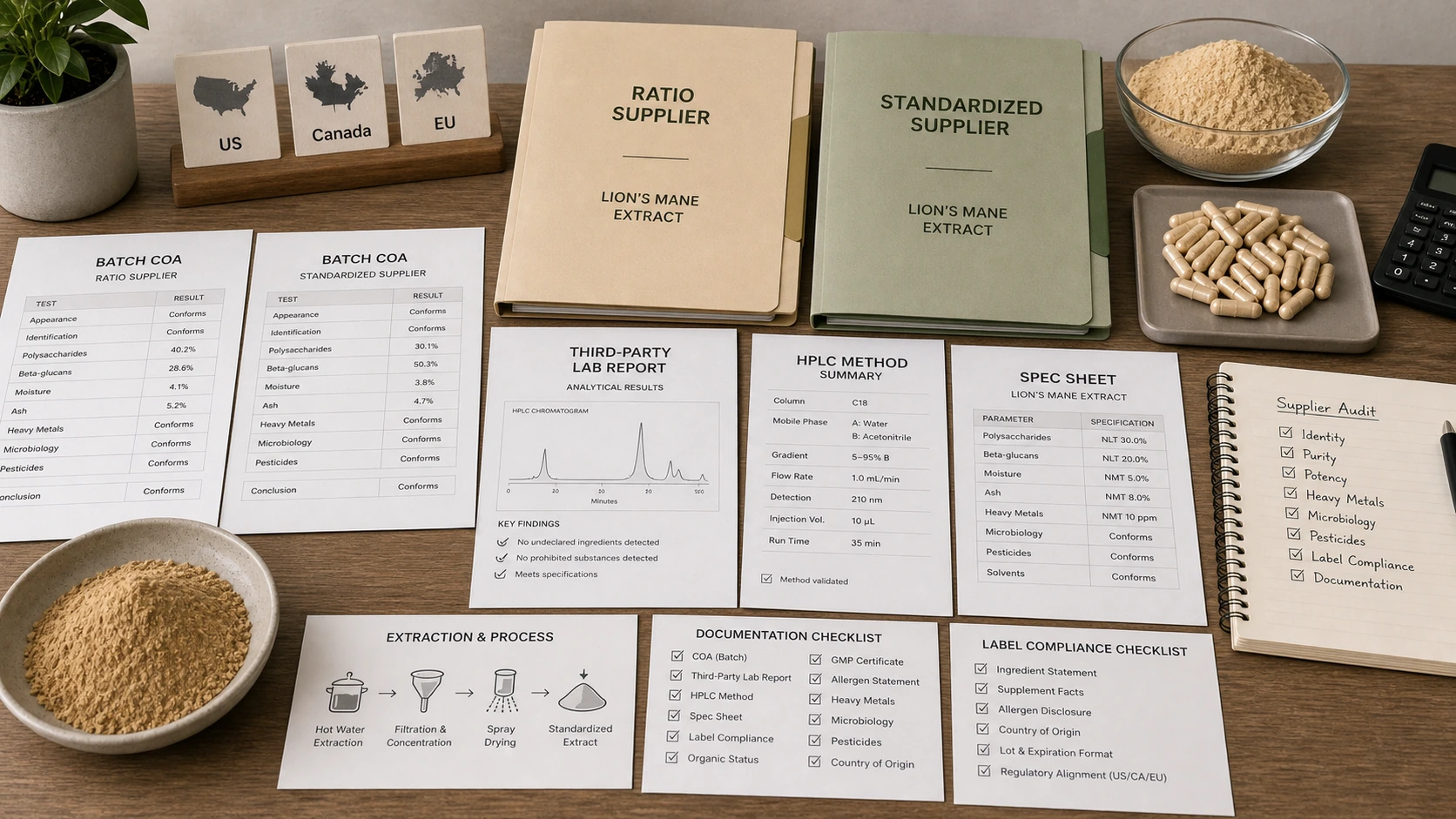
When two suppliers use different spec frameworks, direct comparison requires translating one into the other’s terms. Here is a practical approach.
Step 1: Identify what each COA actually measures. A ratio COA typically lists heavy metals, microbial counts, moisture, and perhaps total polysaccharides by colorimetric assay. A standardized extract COA should list specific compound percentages — beta-glucan, polysaccharides, triterpenes depending on species — with the analytical method stated (HPLC, UV-Vis, colorimetric).
Step 2: Request the analytical method. If a COA states “polysaccharides 30%” without specifying the test method, ask. Colorimetric assay (the phenol-sulfuric acid method) measures total carbohydrates, which includes non-bioactive starches. HPLC isolates beta-glucan specifically. A 30% polysaccharide result by colorimetric assay is not equivalent to 30% beta-glucan by HPLC.
Step 3: Ask for the third-party lab name. In-house COAs and third-party COAs are not the same document. A COA from Eurofins, SGS, or an ISO 17025-accredited lab is independently verifiable. An in-house COA is a self-reported document.
Step 4: Request a sample batch COA, not a specification sheet. A spec sheet describes what the supplier targets. A batch COA describes what a specific production run actually tested at. Ask for both, and compare them.
| Comparison Factor | Ratio Extract Supplier | Standardized Extract Supplier |
|---|---|---|
| Potency claim | Implied by process | Measured per batch |
| Active compound % | Not typically stated | Stated with analytical method |
| COA verifiability | Limited (process claim) | High (lab-specific result) |
| Batch-to-batch consistency | Variable | Controlled to specification |
| Label claim defensibility | Weaker | Stronger |
| Price point (lion’s mane) | Lower | Higher |
This comparison is not an argument that ratio extracts are always inferior — some ratio specifications include verified compound data. It is an argument that when a COA does not include an active compound percentage verified by a named analytical method, the buyer cannot know what potency they are purchasing.
What This Means for Your Label Claims and Regulatory Compliance
Supplement label claims in the US, Canada, and EU are not evaluated against the extract ratio. They are evaluated against the finished product — specifically, the amount of active compound per serving that your label implies.
Under FDA’s DSHEA framework, a supplement company is responsible for substantiating that the product matches its label. If your label says “lion’s mane extract” with an implied potency, and your third-party audit shows the finished capsule falls short, the extract ratio on your ingredient COA is not a defense. The dosing and potency are yours to substantiate.
This is why formulators sourcing mushroom extract powder for regulated markets increasingly specify standardized extracts with HPLC-verified COAs — not because ratio extracts are fraudulent, but because standardized extracts generate the documentation trail that supports a label claim through a product lifecycle. A Eurofins or SGS COA with a stated beta-glucan percentage and test method is a document you can hand to a retailer’s quality team, a contract manufacturer, or an FDA auditor. A ratio specification alone is not.
For brands targeting EU markets, this documentation pressure is higher. EU Novel Food authorization for certain mushroom extracts requires compositional data on bioactive compounds — not extraction ratios.
Frequently Asked Questions
What does a 10:1 extract ratio actually mean for mushroom powder?
A 10:1 extract ratio means 10 kilograms of raw dried mushroom material was used to produce 1 kilogram of finished extract powder. It describes the concentration process — not the active compound content. Two 10:1 extracts from different raw material sources or extraction methods can have significantly different beta-glucan or polysaccharide percentages, which is why ratio alone is not a reliable potency indicator for supplement formulation.
Why is standardized extract more reliable than ratio extract for supplement formulation?
Standardized extract specifies a verified minimum percentage of an active compound — such as 30% beta-glucan by HPLC — measured on each production batch and confirmed by third-party lab testing. Ratio extract specifies only the starting material concentration, not the active compound outcome. For formulators building products with specific dosing targets or label claims, standardized extract provides a defensible, auditable specification. Ratio extract does not.
How do I compare two suppliers using different extract specifications?
Request the analytical method behind any active compound percentage listed on the COA — HPLC for beta-glucan is the most specific and reliable. Ask for the name of the third-party testing lab and a recent commercial batch COA (not a spec sheet). If one supplier lists a ratio and the other lists a standardized percentage, ask the ratio supplier to provide their typical beta-glucan range by HPLC from recent batches. That converts the comparison to the same terms.
Is a higher extract ratio always better for mushroom supplements?
No. A 20:1 extract ratio does not guarantee a higher active compound content than a 10:1 extract. The ratio reflects the concentration of starting material, which varies in quality. A 10:1 extract made from high-grade fruiting bodies with strong beta-glucan content can outperform a 20:1 extract from lower-quality or mycelium-based starting material. The active compound percentage on a verified COA is a more useful quality indicator than the ratio.
The Specification That Actually Matters at the Formulation Stage
The extract ratio vs standardized extract question tends to surface late in sourcing — usually when a formulator is comparing two price quotes and realizes the COAs are structured differently. By then, the timeline pressure is real.
The most useful question to ask any mushroom extract powder supplier is not “what is your extraction ratio” but “what is your beta-glucan percentage by HPLC on your most recent commercial batch, and which lab ran the test.” The answer to that question — or the inability to answer it clearly — tells you most of what you need to know about whether a supplier’s specification is built around what they measure or what they hope.
If you’re currently looking at two COAs that don’t seem to be speaking the same language, that’s usually the right place to start.