
Most sourcing problems don’t show up at the first order.
They show up at the third reorder, when volume doubles, when a new SKU gets added, or when a single factory hits a bottleneck — and the brand suddenly realizes how exposed their supply chain actually is.
A few years ago, a US supplement brand was scaling a Reishi product line. They had gone factory-direct from day one — proud of “cutting out the middleman,” good unit price, clean COAs. Eighteen months in, that single factory’s largest customer doubled their order, and the factory quietly reprioritized its production schedule. Our buyer’s lead time stretched from 4 weeks to 14. By the time they accepted they needed a backup, requalifying a new factory — samples, third-party testing, compliance documents, sample-to-bulk validation — took another 4 months. They missed an entire selling season.
Their competitor, who was sourcing the same ingredient through a sourcing partner with a portfolio of qualified factories, switched to a backup supplier in 9 days.
The cost of “cutting out the middleman” turned out to be a product cycle.
What the Mushroom Extract Supply Chain Actually Looks Like
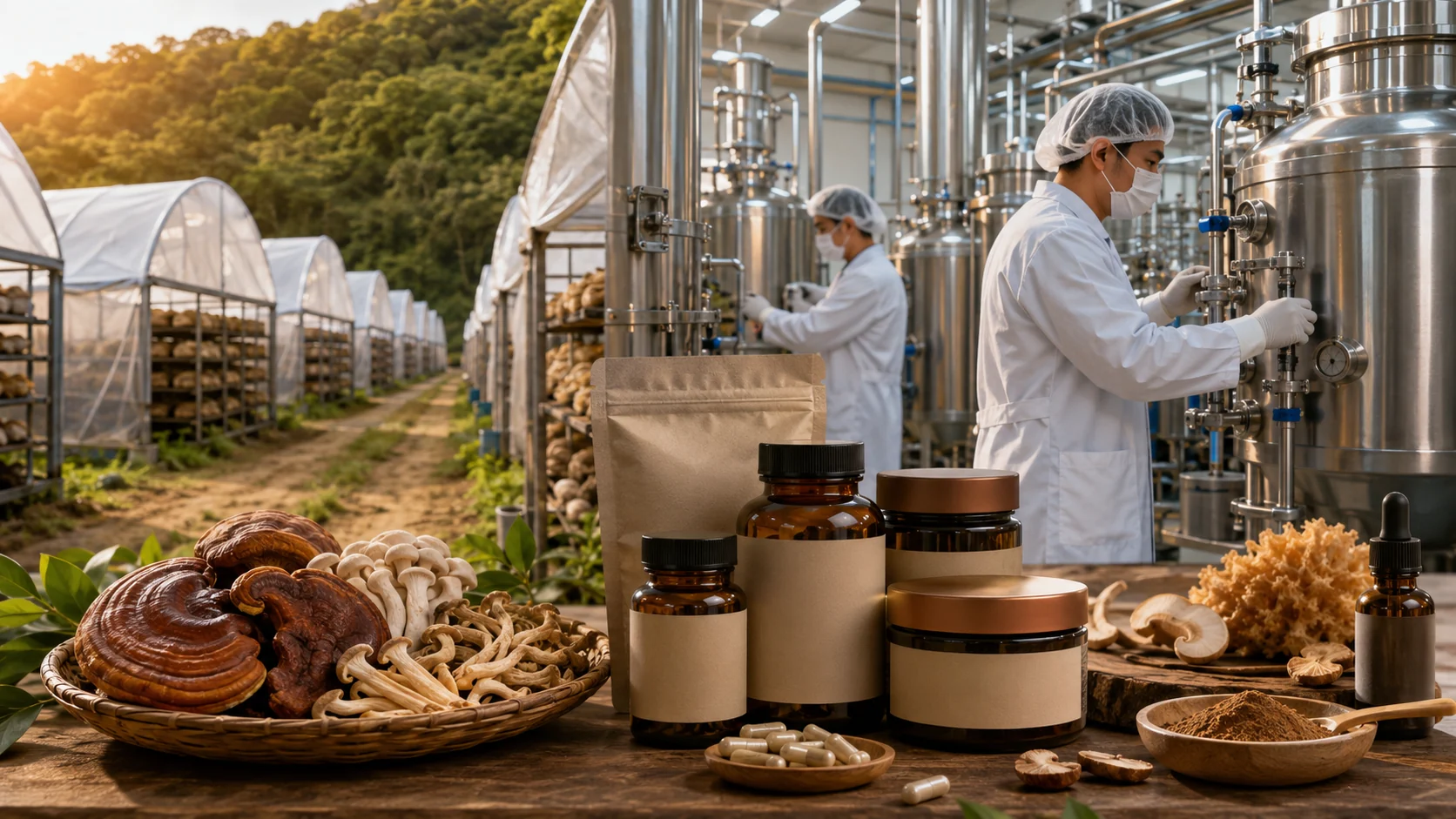
The supplement industry’s supply chain looks simple in a slide deck. In practice, the mushroom extract supply chain has a lot of specialized players:
Cultivation bases → Species-specialized extraction factories → Sourcing partners / trading companies → Brands
Different mushroom species are produced by different factories. The factory best at Lion’s Mane fruiting-body extraction is rarely the same factory best at dual-extracted Reishi, and almost never the same one specializing in Cordyceps militaris fermentation. Each species has its own optimal supplier.
This matters for three reasons:
Category coverage. A brand offering a Lion’s Mane / Reishi / Cordyceps stack going factory-direct ends up managing three separate factory relationships — three sets of MOQs, three lead times, three compliance dossiers, three sets of payment terms. A sourcing partner consolidates all of that under one account, with the best factory selected for each species.
Capacity flexibility. Every factory has capacity ceilings, scheduled downtime, and the occasional regulatory or quality issue. Single-factory dependence becomes a single point of failure. A sourcing partner with multiple validated factories per species can re-route production without the buyer absorbing the requalification cost.
Coordination cost. Managing four to six Chinese factories — sample logistics, batch scheduling, mixed-container consolidation, customs paperwork, COA interpretation, compliance updates — is a full-time procurement job. For most growing brands, that’s a job they shouldn’t have to staff for.
Sourcing Partner vs. Reseller: The Distinction That Actually Matters
There’s a meaningful difference between a real sourcing partner and a basic reseller — and conflating the two is where a lot of bad sourcing advice comes from.
A reseller buys, marks up, and ships. No factory portfolio, no independent QC, no value-add. If the factory has a problem, the reseller has a problem, and so does the brand. This is the supplier type that gives “trading company” a bad name.
A real sourcing partner is structurally different:
Disclosed factory portfolio. A real sourcing partner can name the factories they work with, show factory audit reports, and tell you which facility produces which SKU. They aren’t hiding their supply chain — they’ve built it deliberately.
Independent QC capability. Beyond the factory COA, a sourcing partner runs their own batch testing — heavy metals, microbiology, beta-glucan content, identity verification. This second layer of QC catches what factories sometimes miss, and exists regardless of which factory produced the lot.
Multiple qualified factories per species. For each major species, a serious sourcing partner maintains two to four pre-qualified factories. That’s what makes capacity-flex possible. A factory can only ever offer you itself.
Compliance and documentation expertise. Export licensing, certificate of origin, FDA prior notice, EU import certificates, USDA NOP equivalence, customs HS coding — a sourcing partner handles this end-to-end. A factory typically handles its own paperwork and stops there.
Honest about role. A real sourcing partner doesn’t pretend to be a factory. They’re upfront that they’re a procurement specialist with a factory portfolio, and they treat that transparency as part of their value, not a weakness to hide.
What Documentation Should Look Like

Whether you’re working with a manufacturer directly or through a sourcing partner, the documentation set should look the same. The difference is who pulls it together for you.
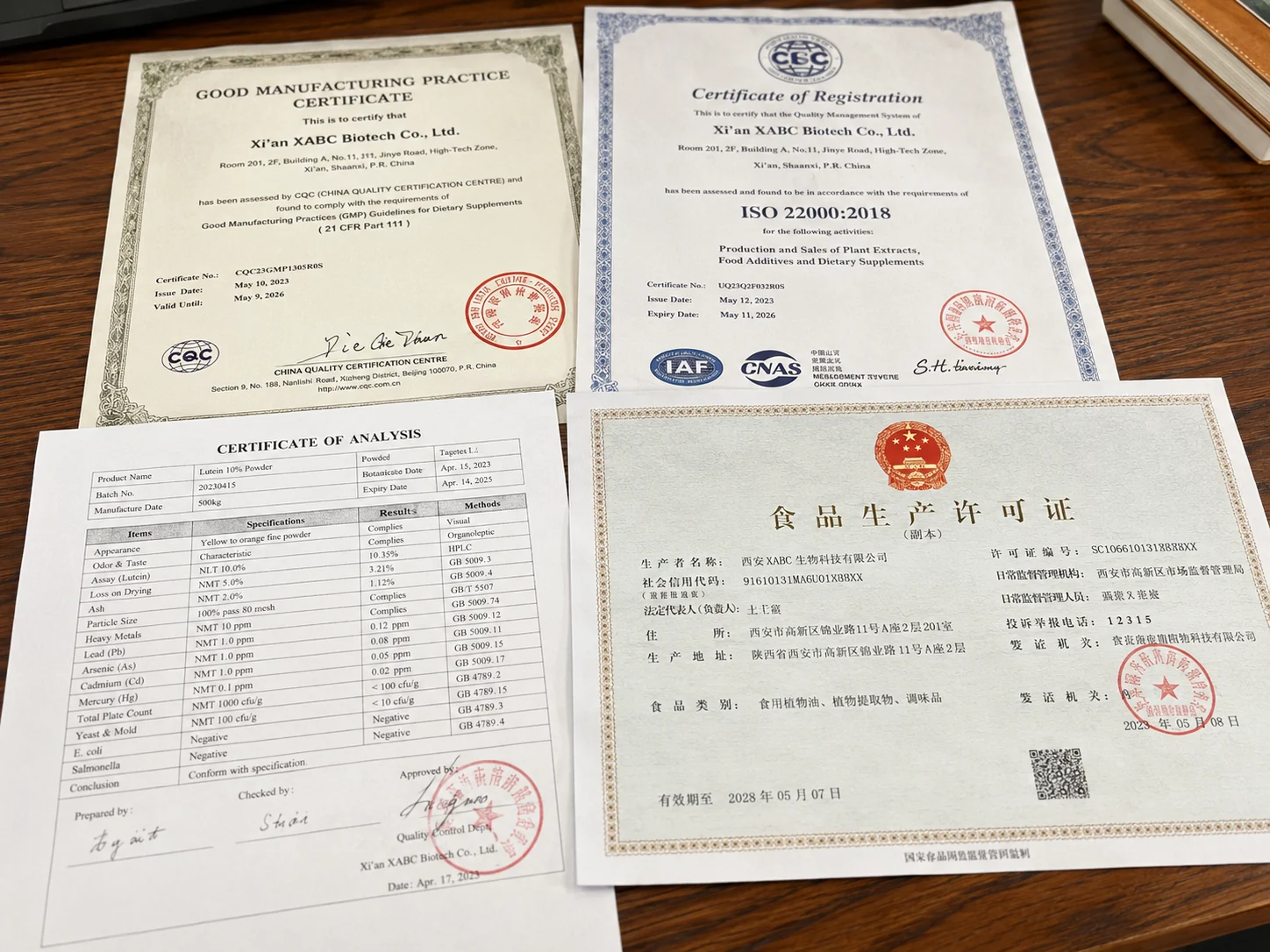
- Business license for the producing facility, with production scope clearly stated
- Food production license (facility-specific, with matching address) for the actual extraction site
- ISO or GMP certification issued to each facility in active rotation
- Third-party audit reports from recognized bodies (NSF, Eurofins, SGS)
- Batch production records, available on request, traceable to the issuing factory
- COA issued by the producing facility, plus independent verification testing
- The sourcing partner’s own export license, trade compliance certifications, and quality SOPs
A factory can show you documentation for itself. A sourcing partner brings you documentation for every factory in the portfolio — plus their own QC and compliance layer on top. When you’re sourcing four species across three factories, having one partner produce one consolidated dossier is the difference between a 2-hour compliance review and a 2-week one.
The Pricing Reality
Unit price comparisons between a factory quote and a sourcing partner quote are almost always misleading, because they compare different scopes of work.
A factory’s quote covers production. A sourcing partner’s quote covers production plus QC, plus MOQ aggregation, plus compliance, plus shipping consolidation, plus the option to switch factories without renegotiating from scratch.
The difference shows up in landed cost and total cost, not in line-item unit price.
A European functional-beverage brand we work with had been quoting Reishi extract direct from a factory and had a 12% lower unit price than what we initially quoted. On paper, the factory won.
The factory’s MOQ was 200 kg per species. The brand wanted five species. That’s a ton of inventory committed up front. When their Lion’s Mane formulation needed a slightly different beta-glucan spec than the factory’s standard line, the conversation went silent for three weeks — they were a small customer making a custom request. Meanwhile, their Tremella supplier had quality issues on one batch, and the brand had no backup factory pre-qualified.
When they moved sourcing to us: aggregated MOQs across our buyer base brought their per-species commitment down to 50 kg, we sourced each species from a factory specialized in it, the custom Lion’s Mane spec got built in a week through a partner factory’s pilot line, and the failed Tremella batch was replaced from a backup supplier within 12 days.
Their landed unit cost went up about 4%. Their working capital tied up in inventory dropped by 60%. Their out-of-stock incidents went to zero.
The number on the invoice isn’t the number that matters.
What a Sourcing Partner Actually Gives You
Beyond the unit-cost conversation, working with a sourcing partner changes what’s possible operationally:
Multi-species coverage under one account. One contract, one payment relationship, one compliance dossier, one point of contact — across whatever combination of Lion’s Mane, Reishi, Cordyceps, Turkey Tail, Tremella, Maitake, Shiitake, or custom blends your product line needs.
MOQ flexibility. Sourcing partners aggregate volume across a buyer base. That means factory MOQs that would otherwise lock out a growing brand become accessible at the volumes the brand can actually move.
QC redundancy. Factory COA, plus the sourcing partner’s independent batch testing, plus optional third-party testing for high-risk SKUs. Three layers of quality verification before the product reaches your warehouse.
Backup factories already in place. No requalification sprint when something goes wrong. The backup is pre-validated, sampled, and on file.
Compliance and regulatory overlay. As US, EU, and Australia markets tighten, the documentation and labeling complexity grows. A sourcing partner who handles this for dozens of buyers each year sees regulatory shifts before they hit individual brands.
Project management for OEM and private label. Mixed shipments, staggered production schedules, custom formulation coordination, label compliance review — the operational layer between “we want this product” and “the product arrived correctly” is exactly what a sourcing partner is built to handle.
Language and time-zone bridge. Native communication with Chinese factories, technical translation for COAs and SOPs, real-time response during US business hours.
When Factory-Direct Does Make Sense
To be clear: factory-direct sourcing is a fit for a real category of buyer. If you’re a very large brand with an in-house procurement team, ordering single-SKU volumes that already exceed factory MOQs, with internal QC labs and compliance staff, with the bandwidth to man