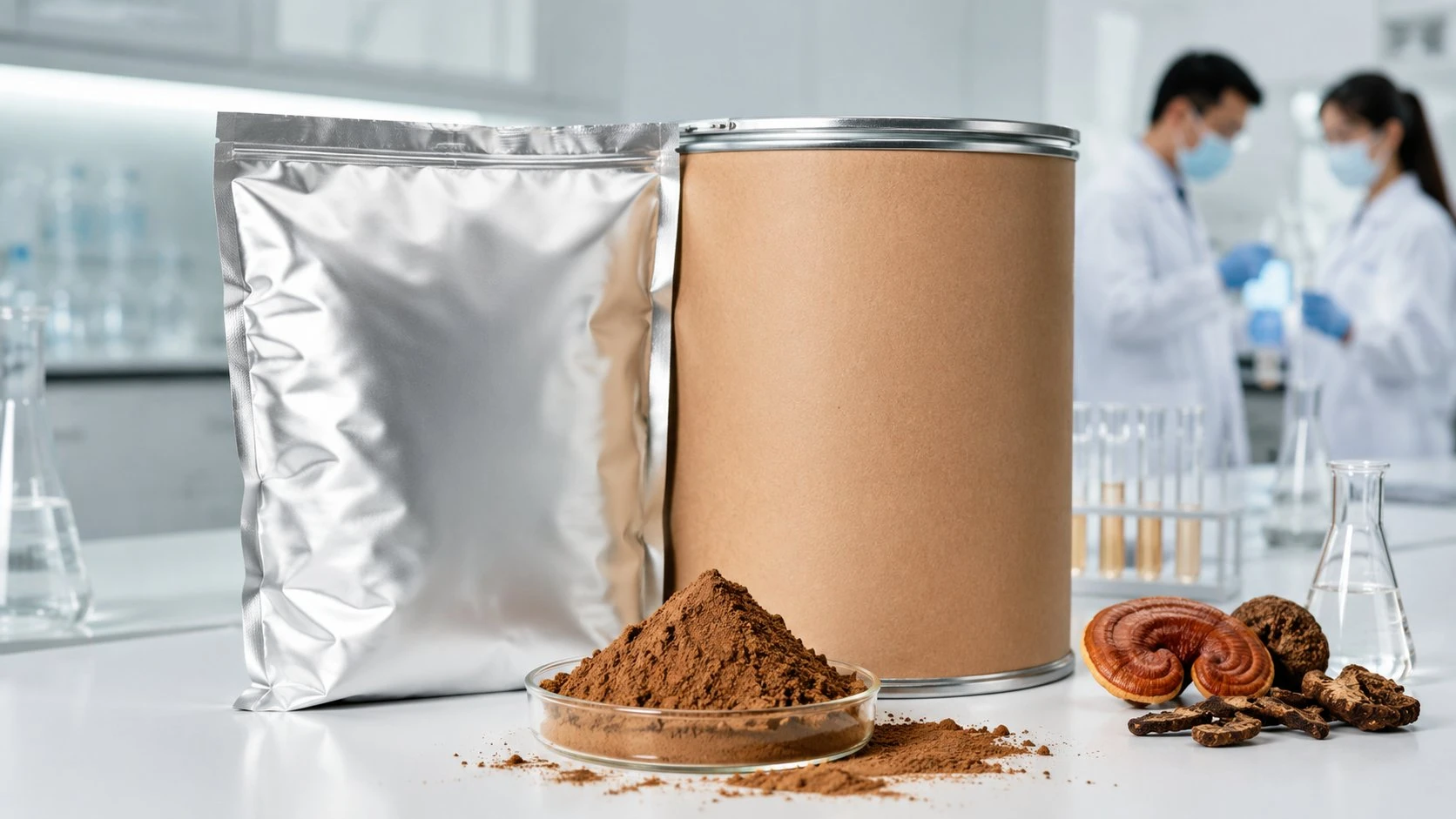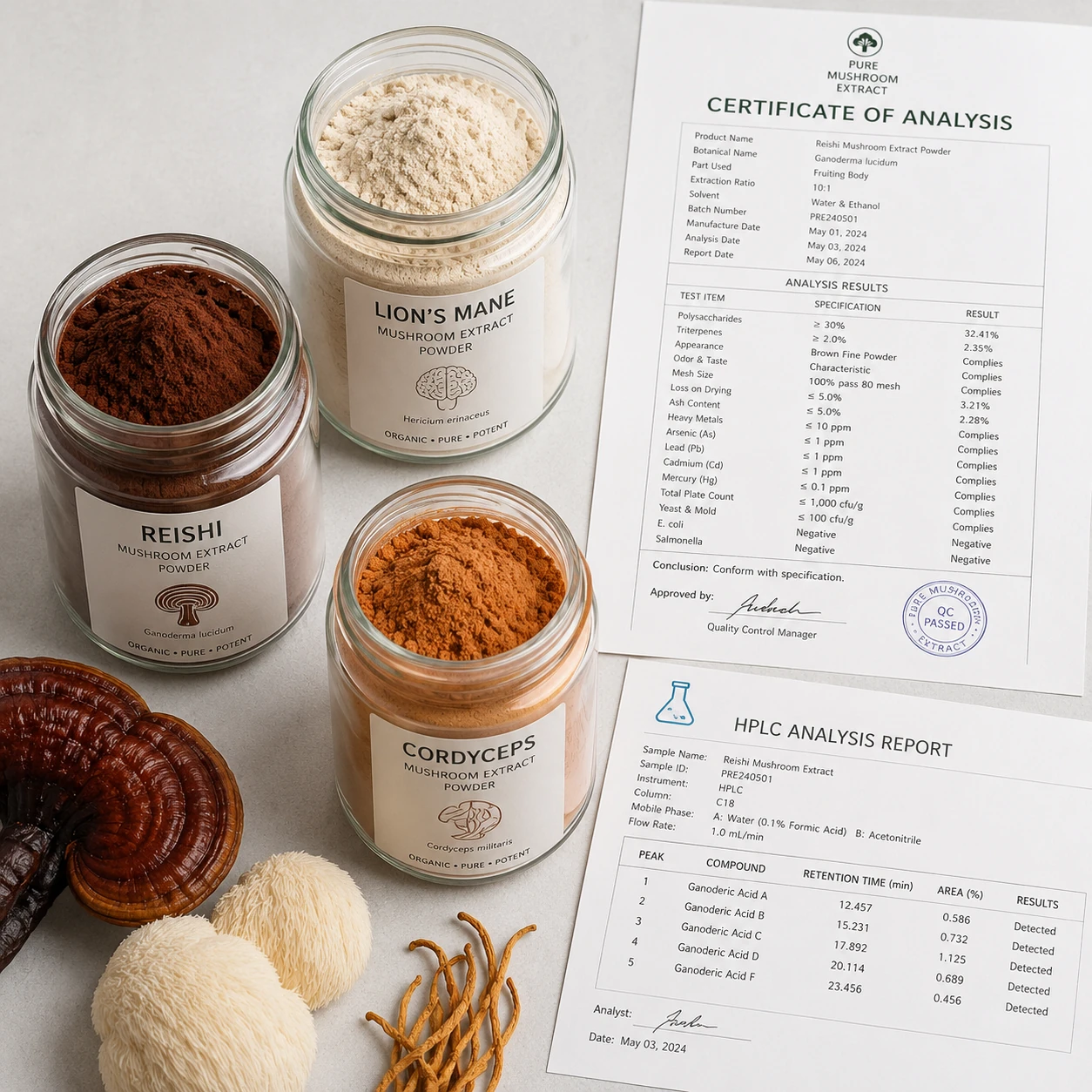
Choosing the wrong mushroom extract manufacturer costs more than a bad batch. It costs reformulation time, market credibility, and in regulated markets, potential compliance exposure. Whether you are sourcing from a direct manufacturer or working through a sourcing partner, the questions you ask before placing a bulk order determine the quality, consistency, and traceability of every unit that reaches your customer. This guide gives B2B buyers a practical framework — not a supplier ranking — for evaluating mushroom extract manufacturers on the criteria that actually matter.
In one case we handled, a supplement brand came to us after spending nearly 6 weeks qualifying a mushroom extract supplier whose COA showed high polysaccharide content but no batch number, no testing method, and no named laboratory. When they sent the sample for independent testing, the result did not match the supplier’s claim. The cost was not only the sample fee — it delayed formulation approval, packaging confirmation, and launch planning. Since then, our first advice to every bulk buyer is simple: before discussing price, verify the batch-specific COA.
What a Mushroom Extract Manufacturer Actually Is (and Why the Distinction Matters)
A mushroom extract manufacturer refers to a facility that controls the extraction process directly — taking raw mushroom material through hot water extraction, alcohol extraction, or dual extraction, then drying and standardizing the resulting powder. This is distinct from a trading company or sourcing agent, which sources finished extract from one or more factories and resells it under their own documentation.
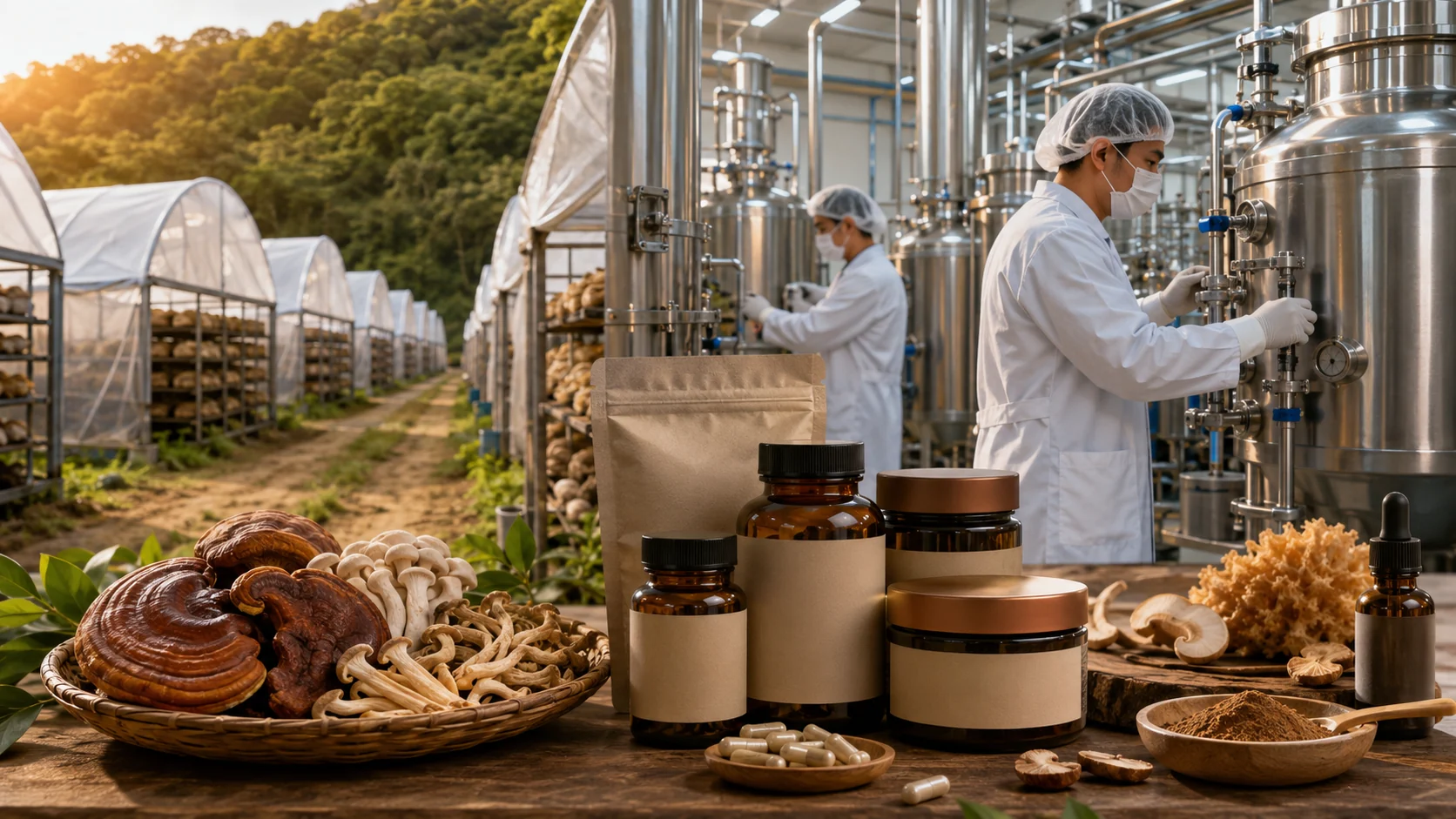
Both models exist across the industry, and neither is inherently superior. A direct manufacturer offers tighter process control and easier factory auditing. A multi-factory sourcing partner may offer greater supply redundancy and faster access to a broader product range. What matters is that you know which model you are working with — and that the documentation you receive accurately reflects the actual production source.
Before any other question, ask: “Are you the manufacturer of this extract, or do you source it from a third-party factory?” The answer shapes every subsequent question about traceability, batch documentation, and audit access.
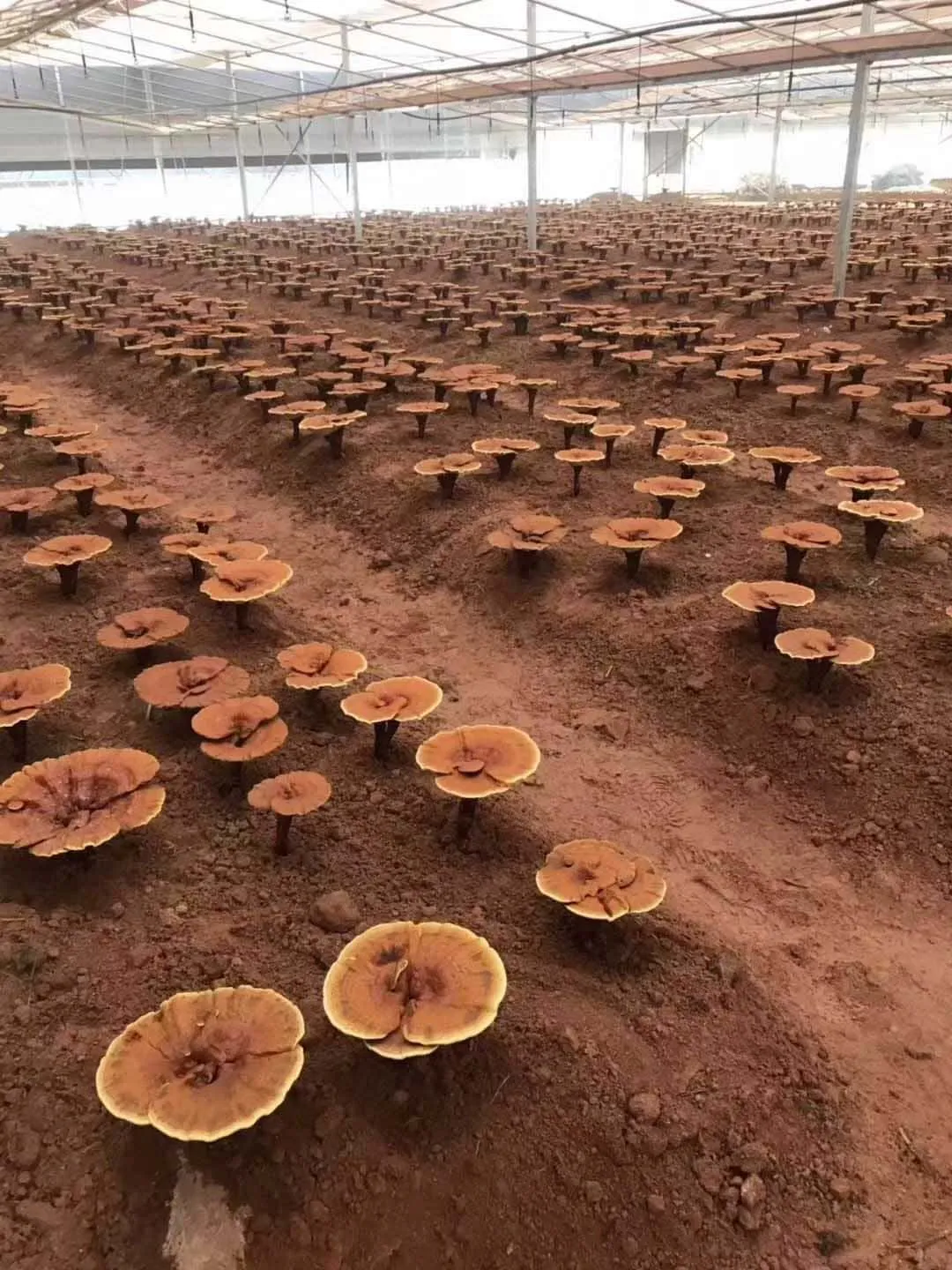
At Molai Biotech, we are a direct manufacturer — our extraction facility, internal HPLC lab, and organic farms are all operated under one management system in Hangzhou, Zhejiang. When a client asks to audit our factory, we give them a date, not a waiting list.
Sourcing organic mushroom extracts for the EU market means certifications can’t be an afterthought. Molai had every document ready — EU Organic, GMP, full COA with third-party results.” — Functional Food Brand, Germany
What Should a Mushroom Extract COA Include?
A Certificate of Analysis (COA) is the primary quality document for any bulk ingredient. For mushroom extracts, a complete COA should include the following regardless of whether it comes from a direct manufacturer or a sourcing partner:
| COA Parameter | What It Verifies |
|---|---|
| Batch number and production date | Traceability to a specific production run |
| Active compound assay (e.g. Beta-Glucan %, Polysaccharides %, Triterpenes %) | Potency and standardization |
| Testing method (HPLC, UV spectrophotometry, enzymatic assay) | Credibility of the assay result |
| Heavy metals (Lead, Cadmium, Arsenic, Mercury) | Safety for dietary supplement use |
| Microbial limits (Total Plate Count, Yeast, Mold, E. coli, Salmonella) | Contamination control |
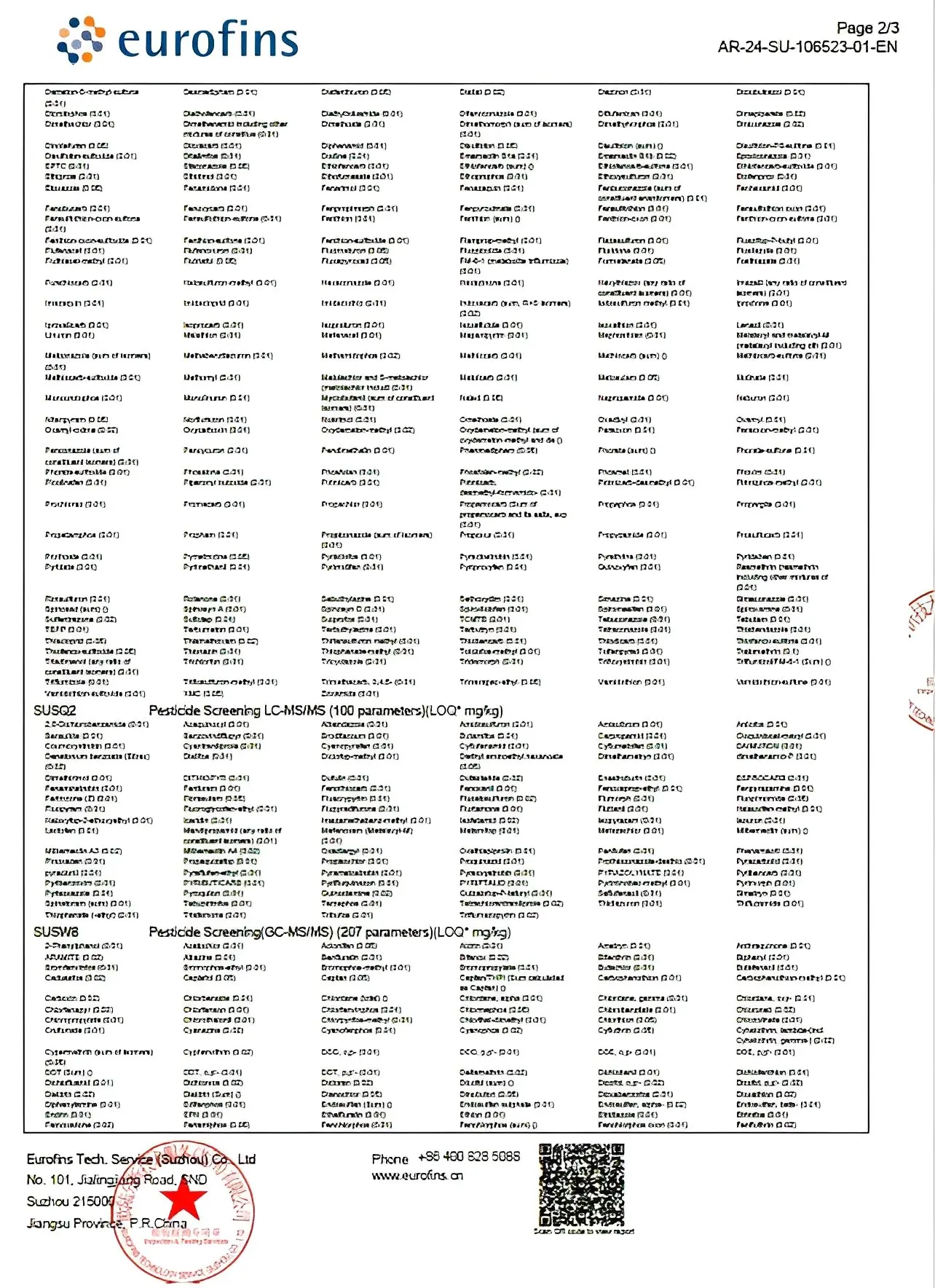
| Pesticide residue | Critical for organic and EU market compliance |
| Moisture content | Stability and shelf life |
| Particle size (mesh) | Formulation compatibility |
| Issuing laboratory name and accreditation | Basis for trusting the result |
A COA that lists polysaccharide content without specifying the testing method — or that is undated, lacks a batch number, or covers an entire product line rather than a specific production lot — is not a batch-specific COA. It is a product specification sheet. The distinction is significant: a spec sheet describes what the product is intended to be; a COA confirms what a specific batch actually measured.
In our own QC process, we do not treat a COA as a marketing document. For every production lot, our team checks the batch number, production date, assay method, active compound result, moisture, heavy metals, and microbial limits before the product is released. For first-time B2B buyers, we often recommend comparing the internal COA with a third-party report from Eurofins, SGS, or another ISO 17025-accredited laboratory. This is especially important for products such as Lion’s Mane, Reishi, Turkey Tail, and Cordyceps, where active compound claims directly affect formulation decisions.
Ask your supplier: “Can you provide the batch-specific COA for the exact lot you intend to ship?” If they cannot, or if they offer a generic document from a prior period, treat this as a red flag requiring follow-up.
For high-value markets or branded supplement lines, third-party verification from an ISO 17025-accredited laboratory (Eurofins, SGS, or equivalent) provides an additional layer of confidence beyond internal factory testing. Learn more about how Molai Biotech handles third-party testing and quality verification.
We’ve had bad experiences with suppliers whose polysaccharide numbers didn’t hold up under independent testing. Molai’s extracts have matched their COA every single time.
How to Compare Direct Manufacturers vs. Sourcing Partners Fairly
The sourcing structure of your supplier affects how you evaluate their documentation and risk profile. Use this comparison as a starting framework:
| Evaluation Criterion | Direct Manufacturer | Sourcing Partner (Multi-Factory) |
|---|---|---|
| Factory audit access | Direct, straightforward | May require coordination with multiple sites |
| Batch traceability | Single production source | Depends on supplier’s own documentation system |
| Supply redundancy | Limited to own capacity | Higher — multiple factory backups possible |
| COA source | Internal lab + third-party | May vary by factory; confirm per batch |
| Price structure | No intermediary markup | Markup may apply; offset by service convenience |
| Custom specification flexibility | Higher — direct process control | Depends on partner’s factory relationships |
| Certification verification | Single set to audit | Confirm certifications per factory, not per partner |
Neither structure eliminates quality risk. What eliminates quality risk is documentation discipline, third-party verification, and your own due diligence. A sourcing partner with rigorous documentation from audited factories can outperform a direct manufacturer with poor internal QC systems.
The key question to ask a sourcing partner: “Can you provide factory-level certifications, COAs, and audit records for each production facility used for my order?”
What Is the Difference Between Extract Ratio and Standardized Extract?
This distinction is one of the most consequential — and most frequently misunderstood — in mushroom ingredient sourcing.
Extract ratio (e.g. 10:1) refers to the concentration factor: how many kilograms of raw mushroom material were used to produce one kilogram of extract. A 10:1 extract means 10kg of mushroom went into 1kg of powder. This ratio describes concentration by weight but says nothing about the actual content of bioactive compounds in the final product. A 10:1 extract of low-potency material can contain lower active compound levels than a 4:1 extract of high-potency starting material.
Standardized extract means the finished powder has been verified to contain a specified percentage of a target compound — for example, Polysaccharides ≥30% by UV spectrophotometry, or Beta-Glucan ≥20% by HPLC. The standardization figure is what actually predicts formulation performance.
| Term | What It Tells You | What It Does Not Tell You |
|---|---|---|
| Extract ratio (e.g. 10:1) | Concentration of raw material used | Actual bioactive compound content |
| Standardized extract (e.g. ≥30% Polysaccharides) | Verified compound content in the finished powder | How the concentration was achieved |
| Mushroom powder (non-extract) | Dried and ground mushroom material | Beta-glucan content, extraction, or standardization |
For B2B supplement formulation, always request standardized extracts with HPLC-verified active compound levels, and treat extract ratio claims without accompanying assay data as insufficient for quality specification purposes.
Ask manufacturers: “Is this a standardized extract? What is the verified Beta-Glucan or Polysaccharides percentage, and what testing method was used to confirm it?”
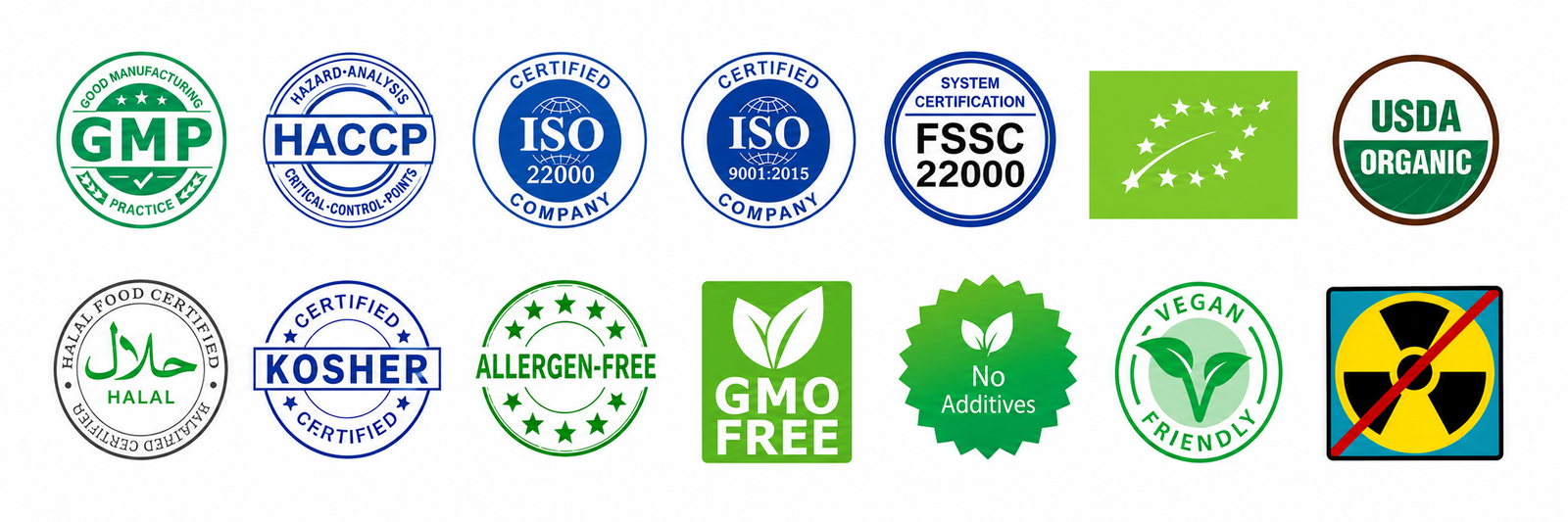
Key Certifications to Request by Target Market
Certification requirements vary by market. Confirm which certifications apply to your distribution geography before placing an order — not after.
| Certification | Applicable Market | What It Covers |
|---|---|---|
| USDA NOP Organic | United States | Organic input verification, no prohibited substances |
| EU Organic | European Union | EC 848/2018 organic standards |
| GMP (Good Manufacturing Practice) | US, EU, global | Manufacturing process control and documentation |
| ISO 22000 / HACCP | Global | Food safety management systems |
| Kosher / Halal | Specific consumer markets | Dietary compliance certification |
| FDA Facility Registration | United States (import) | Required for dietary supplement import to US market |
| EU Novel Food compliance | European Union | Required for certain mushroom species/preparations in EU |
One important nuance: certifications must apply to the specific product and production facility, not just the company. A supplier may hold USDA Organic certification for one product line or one factory while sourcing a separate SKU from an uncertified facility. Always request the certification document itself and verify the scope covers the specific product you are ordering.
Suppliers selling into our OEM and private label markets typically hold multiple certifications by default — but confirm the scope in writing before production begins.
How to Evaluate Batch Consistency Over Time
A single impressive COA does not establish batch consistency. B2B buyers building product lines that carry labelled active compound claims need confidence that results will reproduce across production runs over months and years.
Practical steps for evaluating consistency:
- Request COAs from at least three to five prior batches of the same product. Compare active compound results, moisture content, and heavy metal levels across batches. Significant variance (more than 3–5 percentage points in polysaccharide content, for example) warrants explanation.
- Ask about incoming raw material specification controls. Batch consistency begins with consistent raw material quality. Manufacturers with their own cultivation or tightly controlled agricultural sourcing have a structural advantage in material standardization. See how Pure Mushroom Extract controls the full supply chain from organic farm to finished extract.
- Clarify what happens when a batch falls outside specification. A manufacturer with a serious QC system will have a defined rejection and rework protocol. If the answer is vague, that is informative.
- Request a sample from the same batch as your intended order, not from a prior or separate lot. Confirm the sample COA matches the batch number of the sample shipped.
- Ask about capacity and production scheduling. A supplier operating at or near full capacity may deprioritize quality controls under production pressure. Annual production capacity, lead times for reorders, and backup supply arrangements are all relevant to long-term batch consistency.
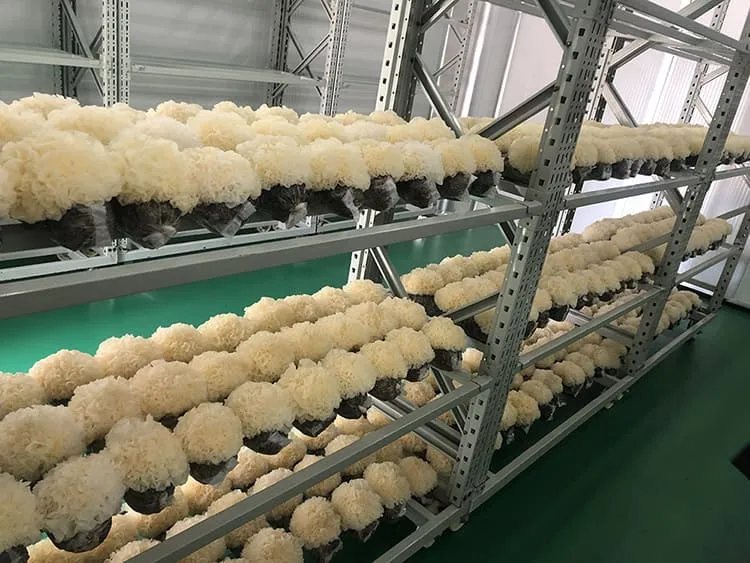
Molai Biotech maintains a 1,200 MT annual production capacity and has supplied B2B partners across 50+ countries since 2005. Clients requesting COA records from prior batches receive them within 24 hours — we maintain full batch documentation going back across production cycles.
Frequently Asked Questions
What should I do if a mushroom extract manufacturer refuses to provide a COA?
Decline the order. A COA is not a premium service or proprietary information — it is a standard quality document that any credible dietary supplement ingredient supplier provides as a matter of course. A refusal typically indicates the supplier lacks the testing infrastructure, the results do not meet stated specifications, or both. There is no compliant pathway to selling finished dietary supplements in the US or EU without batch-level ingredient documentation.
How do I verify that a COA from a mushroom extract supplier is legitimate?
First, confirm the issuing laboratory is named and identifiable — generic COAs without a lab name are unverifiable. For internal lab COAs, cross-check the results against the product specification sheet and ask for a third-party confirmation from an ISO 17025-accredited lab for at least the first order. For COAs from Eurofins, SGS, or equivalent labs, you can often verify report numbers directly through the lab’s client portal. Batch numbers on the COA should match those on the packaging and shipping documentation.
Does fruiting body vs. mycelium matter for COA comparison?
Yes, significantly. Mushroom extract from fruiting body — the actual mushroom cap and stalk — contains the full spectrum of bioactive compounds at concentrations relevant to standardized extract specifications. Mycelium-based extracts are frequently produced on grain substrate, meaning the finished powder can contain substantial starch content (alpha-glucans from grain) alongside the target beta-glucan content. When comparing COAs across suppliers, confirm whether beta-glucan values were measured by an assay that differentiates beta-glucans from total polysaccharides, as some UV methods do not. HPLC or enzymatic assay methods specific to beta-glucan provide more reliable data for fruiting body vs. mycelium comparison.
What is a reasonable MOQ for a first order from a new mushroom extract manufacturer?
For standardized bulk powder, MOQs from direct manufacturers typically start at 25kg per product. Some sourcing partners can accommodate smaller initial orders (1–10kg) for qualification purposes, though pricing per kilogram will be higher. For OEM capsule or tablet production, MOQs commonly start at 50,000 units. For a first order with a new supplier, it is reasonable to request a smaller qualification batch — even at a premium — before committing to larger volumes. Suppliers with strong quality systems will accommodate this; those dependent on volume minimums to offset low margins may resist.
How long does it typically take to receive samples from a mushroom extract manufacturer?
Most established manufacturers can ship 50–100g samples within 24–48 hours for in-stock products. Custom specification samples or blended formulas typically require 7–14 days. If a supplier cannot provide a sample within a reasonable timeframe, or if sample availability is conditional on commitment to minimum order volumes, treat this as a signal about their production flexibility and inventory management.
Conclusion: Build a Sourcing Framework, Not a Supplier List
The goal of evaluating mushroom extract manufacturers is not to find a single approved vendor and stop looking. Market conditions, certification requirements, and production capacities change. The goal is to build a repeatable evaluation framework — one that applies the same questions, documentation standards, and verification steps to any supplier, whether you are qualifying a new partner or conducting a periodic review of an existing one.
The non-negotiables are consistent across all sourcing models: batch-specific COAs with named testing laboratories, HPLC-verified active compound content, relevant market certifications with verifiable scope, and transparent documentation of whether the supplier is a direct manufacturer or a sourcing partner.
Suppliers who meet those standards will welcome the questions. Those who resist them are telling you something important.
If you are sourcing standardized mushroom extracts and want to review batch-specific COAs, certification documents, and specification sheets before requesting a sample, visit our product pages or contact our team directly for a 48-hour quote response.